Skip to content

Community generation

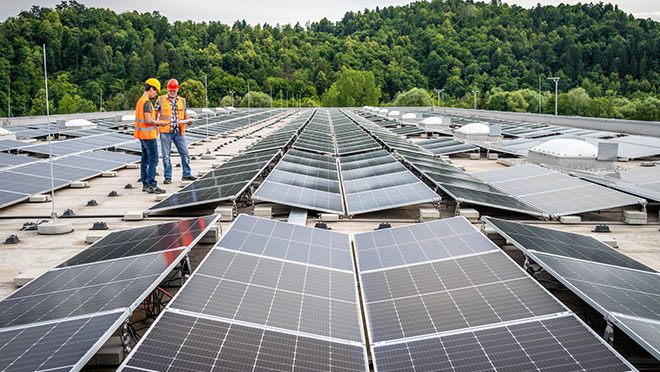
Engineers Working on Solar Panel Maintenance

Generate electricity for your community

Our community generation rate expands access to renewable energy by enabling more customers to benefit from locally produced electricity without installing their own equipment. As a community generator, you host a shared generating facility such as a solar farm and remove common barriers like space and upfront cost. Your facility may primarily serve your own electricity needs, and you also receive the value of any excess energy produced, while benefitting customers subscribe to receive monetary credits on their bill.

If you're looking to only generate energy for your own home or business, explore self-generation to see if it's right for you.

Community generation structure

  • Community generators: Build, operate, and host a shared generating facility. As a community generator your facility may primarily serve your own electricity needs, and any approved excess electricty delivered to BC Hydro is credited to you in the form of monetary credits on your BC Hydro bill.
  • Benefitting customers: Subscribe to a community generation project, typically by paying a fee to the community generator. Based on their allocated share, benefitting customers receive monetary bill credits from excess energy the facility produces. Their electricity service and rate schedule stay the same.

Both the community generator and benefitting customers receive generation credits for the excess electricity produced. These credits help to lower the electricity bills of both you and your benefitting customers.

As the community generator, you have a community generation account (CGA) balance which represents the dollar value of the generation credits in your account.

Depending on the agreement between the community generator and their benefitting customers, these monetary credits can be distributed as bill credits via our optional credit billing service or as a direct monetary exchange (e.g. via Interact e-Transfer).

Benefits of being a community generator

There are multiple benefits to being a community generator, including:

  • Earn monetary value from excess generation
  • Help expand community access to renewable energy
  • Remove barriers such as space, cost, or property limitations for others
  • Maintain ownership and control of the generating facility
  • Manage the list of benefitting customers who subscribe for monetary credits
  • Support local sustainability and community driven renewable energy initiatives

How it works

Community generation is ideal for people who want to operate a shared generating facility and provide their community access to independently generated renewable electricity.

Being a community generator

As the owner and operator of the shared generating facility, you manage a list of benefitting customers who subscribe to your facility.

As a community generator you are responsible for:

  • Finding and recruiting benefitting customers
  • Managing financial credits or compensation between yourself and you benefitting customers
  • Overseeing internal agreements or financial arrangements between yourself and your benefitting customers
  • Retaining records that could be used to confirm eligibility for the rate

While acquiring and maintaining a list of benefitting customers is your responsibility, we have some resources to help you get started. It's also your responsibility to determine the subscription fee and what percentage of generation credits each customer will receive.

You'll also need to work with your contractor to have your generation system designed, get it approved for being on the community generation rate, and installed.

Capacity

Shared generating facilities may be built at any size, provided their net injection to the grid does not exceed 2 megawatt (MW). The allowable export limit is based on the number and type of benefitting customers associated with the project.

The export limit is based on the total number of the benefitting customers' accounts for residential service multiplied by 24 kW plus the number of the benefiting customers' accounts for general service multiplied by 100 kW.

For example, a community generator applying for a generating system with a net injection up to 300 kW, can have the following mixes of benefitting customers:

  • 12 residential customers (24 kW x 12 customers = 288 kW) or
  • 3 commercial customers (100 kW x 3 customers = 300 kW) or
  • 1 commercial and 8 residential customers ((1 customer x 100 kW = 100 kW) + (8 customers x 24 kW = 192 kW) = 292 kW)

Generation credits

Benefitting customers pay their community generator a monthly fee to receive monetary generation credits. As the community generator, you can choose whether to distribute credits from your community generation account (CGA) balance to your benefitting customers yourself or to opt into BC Hydro's optional credit billing service to have the credits applied on your behalf.

An example of credit distribution could look like this:

  • One community generator with 14 benefitting customers who injects 900 kWh into the system.
  • BC Hydro gives $90 total generation credit (900 kWh x $0.10 per kWh).
  • The community generator allocates 30% to themselves (0.30 x $90 = $27) and 5% to each of their benefitting customers (0.05 x $90 = $4.50 each. $4.50 x 14 = $63).

This equates to 100% of the credits being allocated.

BC Hydro offers an optional service where we distribute financial credits from excess generation directly to benefitting customers on their BC Hydro bills.

The community generator customer can choose whether to use this service, manage credit distribution themselves, or hire a third party.

Benefits of this service:

  • Removing the administrative burden for customers who don’t want to handle credit distribution, especially when other market options may not currently exist.
  • Some benefitting customers may prefer having credits applied directly to their BC Hydro bills, similar to how credits work under self-generation (RS 2289). Only BC Hydro can provide this through our normal billing system.

Benefitting customers

A community generation service must have at least two benefitting customers, including the community generator customer itself, to receive 100% of the community generation credit.

A benefitting customer account's maximum allocated share of any community generation account balance may not exceed:

  • 50% if the shared generating facility has four or fewer benefitting customer accounts;
  • 25% if the shared generating facility has between five and nine customer accounts; or
  • 10% if the shared generating facility has ten or more benefitting customer accounts.

Who should participate

You may be a good fit for community generation if you are a:

  • Strata corporation or condominium association with shared rooftop or land space
  • Retail business with available roof area or parking lot canopy space
  • Large retailer or big‑box stores with significant unused rooftop square footage
  • Commercial property owner with multiple tenants
  • Industrial facility or warehouse with expansive roof surfaces
  • Farm or agricultural operation with open land suitable for solar arrays
  • School, university, or community institution with suitable property
  • Municipal building or local government facilities with available space

Examples of community generators include:

  • A strata corporation: Its benefitting customers could be the strata unit owners, who pay for the operation and maintenance of the shared generating facility through their strata fees. The generation from this type of facility would likely be primarily used to offset the community generator’s own load and there may not always be net generation delivered to the BC Hydro system.
  • A third-party as a service (e.g., a solar facility in a field): They solicit eligible customers to become benefitting customers. The generation from this type of facility would primarily and consistently be delivered to the BC Hydro system. These benefiting customers would receive a share of the compensation for the net generation of the shared generating facility in exchange for subscription payments to the third-party.
  • A First Nation: They can have benefitting customers as eligible members located anywhere in the province.

Eligibility

Community generation under Rate RS 2290 is available to both residential and commercial customers. To qualify, the community generator must acquire and manage a list of benefitting customers. Benefitting customers pay a subscription fee to their community generator and receive monthly generation credits. These credits are based on their subscription percentage and the amount of excess energy produced.

You can participate if you meet the following eligibility criteria:

  • Both the community generator and the benefitting customer must be BC Hydro account holders.
  • Must have a minimum of two benefitting customers.
    • Benefitting customer can be residential or commercial or a mix of both.
  • Benefitting customer(s) can be located anywhere in the Province and must be a BC Hydro customer in the integrated service area and non-integrated service area excluding the districts of Kingsgate-Yakh and Lardeau-Shutty Bench.
  • Connected to our distribution system.
  • Use a clean or renewable resource as defined by the Clean Energy Act (such as solar, wind, hydro, etc.).
  • Your shared generating facility must be constructed no earlier than July 1, 2026.
  • A shared generating facility will only be permitted to have a maximum net injection limit of up to 2 MW, prorated based on the number of benefitting customers and with maximum customer allocations.
  • Customers already under the net metering rate (RS 1289) can expand their existing generating facility to qualify for the community generation rate (RS 2290) as it would be considered a new generating facility.

Community generation rate limitations

  • Existing generating facilities under the net metering rate (RS 1289) are not eligible for community generation (RS 2290).
  • A benefiting customer cannot already be taking service under net metering (RS 1289) or self-generation (RS 2289).
  • A benefiting customer is limited to participating in one shared generating facility at a time.

If there are changes to your benefitting customers certain actions must be taken to remain eligible for the rate.

  • Community generators must notify BC Hydro in writing within 30 days of any changes to their benefitting customer list, including any changes to the allocation of the CGA balance.
    • Failure to notify BC Hydro within 30 days may result in termination of the community generation credit billing service if this service was selected.
  • If a change to your benefitting customers reduces the maximum net injection limit, you won’t receive credits or payments for any electricity sent to BC Hydro that exceeds the revised limit.
  • If a change to your benefitting customers results in a higher maximum net injection limit, you must continue to operate the shared generation facility based on the original approved maximum injection limit.
    • You must submit a new generation application to receive approval for the new maximum net injection limit if you would like to operate with that limit.
  • A new benefitting customer authorization form is required for each benefitting customer who subscribes after the original form was submitted.

  • If the community generator customer moves, they must notify BC Hydro in writing within 30 days of any changes to the benefitting customer list, including updates to CGA balance allocations.
  • If a benefitting customer moves but stays in the community generation arrangement and the move out and move in dates overlap, their credits transfer to the new account on the move in date. Credits on the old account will stop at that time.

Apply for community generation

Want to host a shared generating facility? Start by reviewing the application process, the steps involved and what to expect along the way, and the criteria and additional required documents.

Learn more


Once you understand the application process, and have all required documents, you may begin your application.

Start your application

Already applied? Check your application status or upload necessary documents. You'll be prompted to log in first.

Incentives

We offer financial incentives to help industrial and large commercial customers reduce the cost of their generation projects. These custom incentives are developed on a project-by-project basis and based on the amount of energy saved or load displaced at your site.

Projects will receive custom incentives only if the estimated solar energy used for load displacement (kWh/year) is at least 80% of the total solar energy generated (kWh/year). Learn more about custom project incentives and incentive amounts.

Please note, your incentive application must be reviewed and approved first. It takes approximately four to six weeks to process your incentive application, after which we can process your grid connection application.

As a part of your community generation application, you will need to provide the following additional documents:

  • Benefitting customer spreadsheet [XLSX, 45 KB]
    • A list of your benefiting customers, their contact and BC Hydro account information
  • Benefitting customer authorization form [PDF, 93 KB]
    • Confirms the benefitting customer has entered an arrangement with a community generator customer and includes any other authorizations required by BC Hydro
    • If the community generator selects the community generation credit billing service available under this rate schedule, authorization from each benefitting customer is required to permit deductions from the Community Generation Account (CGA) balance as applicable.
  • Optional credit billing service agreement
    • This form is only required if you will be participating in the optional credit billing service.
    • This service allows BC Hydro to distribute financial credits from excess generation directly to benefitting customers on their BC Hydro bills.

Resources

Resources for benefitting customers

If you’re interested in becoming a benefitting customer, see our resources for guidance on choosing a project to subscribe to and how it may benefit you.

Rate activities

For recent regulatory activities and updates related to the community generation rate, see our current rate design activities.