Skip to content

Rebates for solar panels and battery storage

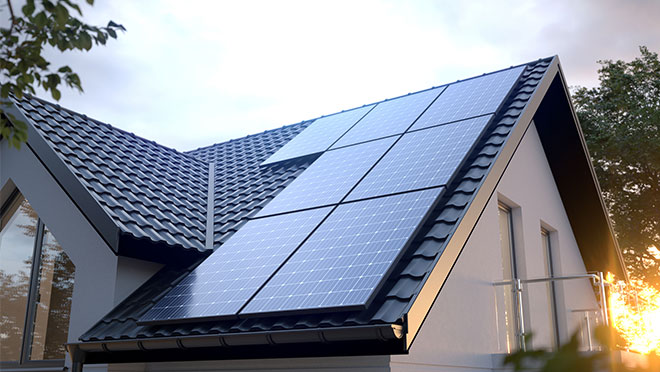
Solar panels installed on the roof of a residential home with sunlight shining in the background.

On this page:

Save on eligible solar panels and battery storage

We're offering rebates on eligible solar panels and paired battery storage systems to help customers participate in self-generation and reduce electricity costs over time.

This is one of the ways we're helping meet the province's growing need for renewable electricity and providing you with more options for managing your energy use.

Rebates are available on a first come, first served basis for qualifying customers and buildings while funding lasts.

If you are an industrial or large commercial customer, you may be eligible for load displacement incentives to help reduce the cost of your generation project. Learn more about load displacement incentives.

Solar panel rebates

Rebate amountsAmount available
Rebate per kW
  • $1,000 per kilowatt (kW) of installed DC generator capacity.  
Rebate maximum
  • 50% of total installed product cost (including labour and materials) and limited to the following maximums by type.
    • $5,000 for residential homes (individually metered)
    • $10,000 for commercial or multi-unit residential buildings
    • $50,000 for social housing providers, Indigenous governing bodies, and remote microgrid communities

Battery storage rebates

Rebates are available for battery storage systems installed with a solar panel system. Battery-only systems are not eligible except for residential customers who enroll their battery in Peak Saver.

Rebate amountsAmount available
Rebate per kWh
  • $500 per kilowatt hour (kWh) of installed storage capacity.
Rebate maximum
  • 50% of total installed product cost (including labour and materials) and limited to the following maximums by type.
    • $1,500 for residential homes (individually metered)
    • $5,000 for residential homes (individually metered), if battery is enrolled in Peak Saver
    • $10,000 for commercial or multi-unit residential buildings
    • $50,000 for social housing providers, Indigenous governing bodies, and remote microgrid communities

See our qualified product list for battery storage here [PDF, 170 KB].

How to apply

  1. Review all requirements before you purchase or install your system including the general rebate eligibility criteria below, the solar and battery rebate terms and conditions[PDF, 120 KB], and self-generation interconnection requirements.
  2. Find a Home Performance Contractor Network (HPCN) member to design and install your solar and/or battery storage system. We recommend getting at least three quotes and comparing your quote to B.C. cost averages.
  3. Submit a self-generation application before you install. Work with your contractor to create and submit a self-generation application and if eligible, apply for a rebate. We strongly recommend waiting to purchase generating equipment until after the self-generation application is reviewed and accepted.
  4. Receive technical acceptance for your self-generation system from BC Hydro before your licensed contractor installs the system.
  5. Submit your final inspection documents to receive interconnection approval. If eligible, enroll your battery in Peak Saver within 14 days of interconnection approval to maximize your rebate. 
  6. Your rebate application will be processed and paid within 45 business days after interconnection approval. 

See our guide [PDF, 68 KB] for more details on the application process and what to expect.  
Start by viewing all eligible communities and their current availability for self-generation on our map[PDF, 584 KB]. 

Before submitting your application, we encourage you to email us with your project details, to enquire about the current status of your community's capacity or any other questions you may have about your project.

When you submit a self-generation application for your proposed system, we'll review the proposed system and let you know if any changes or additional requirements are needed to ensure your project is compliant with system limitations in your area.

Each application will be reviewed thoroughly and evaluated on a case-by-case basis. We cannot guarantee acceptance due to the capacity of each eligible community.  

Landlords and developers may need to follow a different rebate application process. This is for a property that:

  • They own or have newly built
  • The BC Hydro account for that property is not in their name

If the landlord or developer owns the tenanted or newly constructed property and the account is in their name, follow the application steps listed under the how to apply section.

If the BC Hydro account for the tenanted or newly constructed property is not in the name of the property owner, follow these steps in addition to those in the how to apply section:

  1. With the help of your contractor, create a self-generation application and send it to the BC Hydro account holder for review and approval. Make sure to use the e-mail address the account holder (tenant) uses to sign into their MyHydro account. 
  2. As the BC Hydro account holder, the tenant must agree to participate in self-generation, since their rate will change and they will receive the benefit of the self-generation credits on their bill. When they review the self-generation application, the tenant will respond “no” to being the registered property owner. They'll then be asked to agree to the utility account holder consent, which will give the property owner permission to apply for the rebate separately using the tenant's account information.
  3. Download and fill out the Landlord or developer rebate application form[PDF, 91 KB]. Once complete, follow the instructions on the form to submit it. We encourage email submissions when possible to avoid delays in processing.
  4. Once the self-generation application has been reviewed and accepted by BC Hydro, the property owner can submit the rebate application using the self-generation application number and the tenant's account information.  

Properties with temporary service connections are not eligible for rebates. Self-generation applications for buildings under construction should remain in draft until a permanent meter is installed and a new BC Hydro account is created and linked to the application.

Submitting multiple applications with a single rebate payee

Contractors drafting an application for a project with a single rebate payee (e.g. social housing provider) have the option to copy the application they’ve filled out to use as a template. The additional applications should be similar to the one completed with a similar system set up.

Make sure all submissions are included in this bulk application, as you will not be able to add to this bulk application once you complete your last submission.

Please note, bulk applications must be completed in one sitting as they cannot be saved as drafts.

A Landlord or developer rebate application form may be required if the BC Hydro account for the property is not in the name of the property owner.

City of New Westminster Electrical Utility customers are eligible for residential solar and battery rebates through the City's program. You can review the customer, property, installation and system eligibility criteria on this webpage before applying.

To review additional criteria and apply visit their website. For questions or more information, you can contact them here.

Social housing providers and Indigenous governing bodies who own a residential property in New Westminster are not yet eligible for solar and battery rebates.  

Customer and property eligibility

Depending on which customer category you fall under, there is additional eligibility criteria you must meet.  

  • The property must have a BC Hydro or City of New Westminster residential account.
  • Customers of other utilities within B.C., such as FortisBC, are not eligible for these rebates.
  • You must own the property. Tenanted properties are eligible but the rebate is paid to the registered property owner. 
  • The property must be a grid-connected residential home. This includes residential homes in Indigenous communities.
  • The property must be located in BC Hydro's service territory[PDF, 176 KB].
  • Eligible property types include:
    • Single-family detached dwellings.
    • Duplex, triplex, row home or townhomes.
    • Mobile homes that are fixed to a permanent foundation that are structurally complete with installed and connected plumbing, heating, electrical, water and sewer services, and with towing apparatus and axle removed.
    • Detached garages and secondary structures. Structures must be connected to the same BC Hydro account and meter as the main residence or served by an adds to meter under the same primary residential account. Installations on buildings with a separate account or meter are not eligible.
    • Farm properties billed on a residential rate. Including systems installed on farm related buildings, such as barns, workshops, storage buildings, or other agricultural structures if they are billed on a residential rate.  

  • Your business property is owned or leased by you. 
  • You're the business account holder paying Small General Service, Medium General Service rates, or Large General Service rates.
  • The property must be grid-connected.
  • You must have a BC Hydro business account.  

  • You're an Indigenous governing body[PDF] 
  • The property must be grid-connected.
  • Eligible property types include:
    • Multi-unit residential buildings, located in BC Hydro’s service territory including low-rise, high-rise apartments and stacked townhome buildings, three stories or higher on a single meter or strata common area account.
    • Commercial buildings served under an eligible commercial building rate (including Small, Medium, or Large General Service rate).

If you’re an Indigenous governing body who owns an individually metered residential property, rebates maximum is $5,000 for solar and $1,500 for battery (or $5,000 if enrolled in Peak Saver). See our section on residential customer and property eligibility.

If you're an Indigenous governing body located in one of our non-integrated areas (i.e., remote microgrids), see our sections on remote microgrid communities.

  • Multi-unit residential buildings, located in BC Hydro’s service territory including low-rise, high-rise apartments and stacked townhome buildings, three stories or higher. Single-family detached dwellings are not eligible.
  • You must be the building owner, strata council member or property manager of your multi-unit building.
  • The property must be a grid-connected, multi-unit building.
  • You must have a BC Hydro common area account or be served by a single meter.  

  • You must be a non-profit housing provider that is a:
    • Charity registered under the Income Tax Act (Canada), or
    • Housing society registered under the Societies Act, or
    • Housing co-op registered under the Cooperative Association Act.
  • The property must be grid-connected.
  • Eligible property types include:
    • Multi-unit residential buildings, located in BC Hydro’s service territory including low-rise, high-rise apartments and stacked townhome buildings, three stories or higher on a single meter or strata common area account.
    • Commercial buildings served under an eligible commercial building rate (including Small, Medium, or Large General Service rate).
  • Mixed use residential buildings must have at least 50% of the total floor areas as residential living space.
  • Equity co-op housing societies are not eligible for social housing rebates.
  • If you’re a social housing organization who owns an individually metered residential property, rebates maximum is $5,000 for solar and $1,500 for battery (or $5,000 if enrolled in Peak Saver). See our section on residential customer and property eligibility.

  • You're an individual or Indigenous governing body who owns a home or business.
  • The property must be grid-connected.
  • The building(s) must have a BC Hydro residential or business account.
  • The property must be in an eligible community.
  • Eligible residential property types include:
    • Single-family detached dwellings.
    • Duplex, triplex, row home or townhomes.
    • Mobile homes that are fixed to a permanent foundation that are structurally complete with installed and connected plumbing, heating, electrical, water and sewer services, and with towing apparatus and axle removed.
  • Unheated, seasonal or unoccupied buildings are not eligible.

Eligible communities

You must live in one of the following communities:

  • Anahim Lake, Nimpo Lake
  • Atlin
  • Bella Bella, Shearwater, Waglisla
  • Bella Coola, Firvale, Hagensborg
  • Dease Lake
  • Ehthlateese
  • Kwadacha (Fort Ware)
  • Good Hope Lake, Jade City
  • Hartley Bay
  • Masset, Old Massett, Port Clements
  • Sandspit, Daajing Giids, Skidegate, Tlell
  • Telegraph Creek
  • Toad River
  • Tsay Keh Dene

The following communities have currently reached their self-generation limit:

  • Bella Coola, Firvale, Hagensborg
  • Ehthlateese
  • Kwadacha (Fort Ware)
  • Masset, Old Massett, Port Clements
  • Sandspit, Daajing Giids, Skidegate, Tlell

Additional considerations

  • BC Hydro's remote microgrids use a variety of generation resources to support their electricity load, such as diesel, existing or proposed independent power producer (IPP) renewable generation, and intermittent energy via self-generation.
  • In remote microgrids, BC Hydro limits the aggregate self-generation in the community to 15% of the average community load (measured in kilowatts, or kW). This limit of intermittent renewable energy (solar, wind) is due to the smaller size of these grids compared to the integrated system. Staying within this limit ensures BC Hydro can provide safe, reliable and affordable service for all customers within the remote microgrids. Learn more about self-generation and diesel reduction [PDF, 149 KB].

BC Hydro will complete a thorough technical review and evaluation for each application for self-generation from remote microgrid customers on a case-by-case basis until the limit for the respective community microgrid is reached.  

Rebates are per BC Hydro account (not per system or sub-meter) tied to a qualifying property. Properties with multiple accounts, systems or meters may be eligible in the following circumstance.

Eligible residences must be distinct dwellings, such as a primary home and a coach house, and not part of the same internal building structure.

Secondary suites or individually metered units within a single residential building (e.g., basement suites, strata units, or apartments) are not eligible, even if separately metered.  

Installation and system eligibility

The eligibility criteria outlined in this section applies to all customer types in addition to the criteria under the applicable customer and property type eligibility.

To be eligible for rebates, your system needs to be reviewed and approved to connect to our grid through self-generation. 

As of July 1, 2026, the net metering service rate (Rate Schedule 1289) will be closed to new customers, and a new self-generation service rate (Rate Schedule 2289) will apply. You can learn more about this rate change here. 

Customers who received a BC Hydro solar rebate before March 24, 2026 may be eligible for a one-time rebate repayment option to remain on the net metering service rate (Rate Schedule 1289). Visit the Solar rebate repayment request page for more information.

For complete eligibility and program details, see our solar and battery rebate terms and conditions[PDF, 120 KB].  

  • Solar generation must connect to our distribution system through self-generation.
  • You must receive application pre-approval before purchasing equipment. This is to ensure your project meets eligibility and safety requirements.
  • Systems must have a combined aggregate nameplate capacity of no more than 100 kW. 
  • Installations and connections must be completed after June 27, 2024. 
  • Ground-mounted and detached garage-mounted installations are eligible if they’re fixed to the property and connected to the primary BC Hydro account/meter for the property. For residential properties, the system must serve the primary residence.
  • Temporary or mobile installations aren't eligible.
  • Self-installations aren't eligible. Must be designed and installed by a Home Performance Contractor Network (HPCN) member to be eligible for rebates.
  • Replacements of system components that increase the size or capacity of your system are eligible for a rebate for the incremental increase of the system's size or capacity. For example, if you're replacing a 5 kW system with an 8 kW system, the 3 kW increase is rebate eligible.

Additional requirements for remote microgrids

  • Solar generating systems must be no larger than 10kW per residential single-family home and 100kW for business.
  • Solar only systems can be exporting, while solar battery systems must be non-exporting.
  • Solar battery systems must be configured to charge from solar energy only.
  • If the batteries are not maintained or fail, the solar panels must remain non-exporting.  

  • Has a nameplate rating of no more than 100 kW.
  • Must be new, not previously installed in another home or property.
  • Must be purchased in Canada; products can be manufactured outside of Canada.
  • Cannot replace an existing solar photovoltaic system. However, additional solar panels added to an existing system will qualify. 
  • Is Canadian Standards Association certified and is compliant with CSA C22.2 No. 107.1:16 (R2021), CSA C22.3 No. 9:20 and CSA C22.2 No. 61730. See terms and conditions[PDF, 120 KB] for more details. 
  • Tesla products are not eligible. See our product FAQ for more information.

Additional requirements for remote microgrids

  • The solar inverter must be certified to UL1741SA as the minimum for enhanced ride-through capability.
  • Solar generating systems must be no larger than 10 kW per residential single-family home.
  • Solar-only systems may be configured to exporting, while solar and battery systems must be configured to non-exporting.

  • Must be new, not previously installed in another home or property.
  • Must be purchased in Canada; products can be manufactured outside of Canada.
  • Cannot replace an existing battery energy storage system. 
  • Is compliant with CSA C22.2 No. 107.1:16 (R2021), CSA C22.3 No. 9:20.
  • Battery energy storage systems must be certified to CUL 1973 and CUL 9540, and if installed in the habitable or living space of a dwelling must be tested to pass CUL9540A requirements. See terms and conditions[PDF, 245.2 KB] for details.
  • Batteries that meet the certification requirements are included on our qualified battery list[PDF, 159 KB].
  • Tesla products are not eligible. See our product FAQ for more information.
  • Batteries installed without a solar generator (new or existing) are not eligible except for residential customers with batteries enrolled in Peak Saver.

Additional requirements for remote microgrids

  • Solar-only systems may be configured to exporting, while solar and battery systems must be configured to non-exporting.
  • Solar and battery systems must be configured to charge from solar energy only.
  • If batteries are not maintained or fail, the solar power must remain non-exporting.
  • Customers who reside in remote microgrid communities are not eligible for Peak Saver. 

Apply now

Ready to apply? You'll need to log in to your MyHydro account to start your application.

Apply now

Already applied for a rebate? Check your status

This tracker lets you check your rebate status after your self‑generation application is approved and your system is connected to the grid.

Resources

Beginning June 1, 2026, solar and battery installations must be completed by a Home Performance Contractor Network (HPCN) member in order to be eligible for rebates. 

HPCN members have completed best practices and rebate program training, are committed to ethical business practices, and are subject to ongoing quality assurance requirements. They also meet basic eligibility standards such as WorkSafeBC compliance, valid business licences, general liability insurance, and standard warranties.

HPCN members are independent businesses and are not affiliated with or employees of BC Hydro. BC Hydro does not endorse, warrant, or guarantee their work. It is the customer's responsibility to research, select, and oversee the contractor that best meets their needs.  

HPCN members will:

  • Design and install your clean or renewable energy system safely
  • Optimize your system size based on your electricity use profile
  • Follow all jurisdictional requirements including securing permits
  • Assist with the application process.

Provide estimated monthly savings and may be able to assist with calculating the payback of your project

Please note, contractors may not submit applications on behalf of customers and should never request MyHydro login credentials.

Be wary of claims that sound too good to be true, like “free solar,” aggressive sales tactics, time pressure and limited‑time offers to sign contracts or requests for in-kind contributions, like manual labour, in exchange of free solar installation.  

Try our residential battery usage calculator

Need help to determine the best battery size for you and your home? Try our battery usage calculator to help you decide. Already have a battery storage system? Use this tool to help assess your current usage. Try our calculator.

Safety guide for installation 

For details on how to safely install a battery storage system inside or outside of your home, please see our guide [PDF, 259 KB].

Learn about battery energy storage system

Visit our webpage batteries for power storage to learn more about how this technology works. 

To learn more about residential solar power, see our product resource page for solar panels.

Related offers