

For questions about self-generation and the application, please email us.
Visit our self-generation page for program details and resources.
You can manage your self-generation application and account through MyHydro.
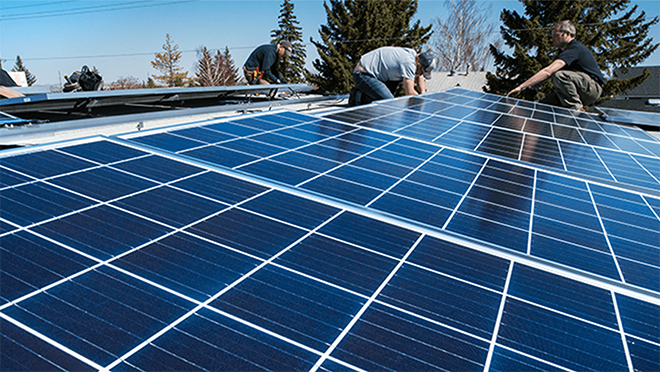
Self-generation – previously called net metering – is designed for those who want to reduce their electricity bills and gain energy independence by generating their own electricity. It allows you to power your home or business with your privately generated renewable energy, with the flexibility to rely on our grid if you need it.
As of February 2026, over 17,000 customers are participating in self-generation, with the majority using a solar photovoltaic (PV) system. Some customers install a battery to store excess energy they generate to use when they want to, or as backup energy during a power outage.
Self-generation is ideal for people looking to lower their electricity costs and achieve energy independence by producing their own power.
If your generation system, for example solar panels, produces more electricity than you use, the excess energy will earn generation credits on your bill. These credits are applied as a dollar amount to help reduce your future electricity costs. For each billing period, you'll be compensated at a fixed rate of 10 cents per kWh for the excess electricity you generate.
Work with your contractor to have your generation system designed, accepted for self-generation, and installed. Once it’s connected to the grid, you’ll be able to offset your electricity costs by generating your own power.
Self-generation is open to residential and commercial customers. You can participate if your electricity generators meet the following eligibility criteria:
Reduce the payback period of your project by taking advantage of our rebates for solar panels and battery storage and load displacement incentives.
We're offering rebates on solar panels and energy storage systems for residential and business customers participating in our self-generation rate. Review the rebate offer details in the planning stage of your project to ensure that your property, equipment, and installation will qualify.
View solar panel and battery storage rebate information here.
We offer financial incentives to help industrial and large commercial customers reduce the cost of their generation projects. These custom incentives are developed on a project-by-project basis and are based on the amount of energy saved or load displaced at your site.
Projects are eligible for custom incentives only if the estimated load displacement from the solar energy generation is 25,000 kWh/year or more. Learn more about load displacement incentives.
Please note, your incentive application must be processed first. It takes approximately four to six weeks to process the incentive application, after which we can proceed with your grid connection application.
Interested in self-generation? Start by learning how applications work.
Use the same application to apply for rebates on eligible solar panels or battery storage.
Already applied? Check your application status or upload necessary documents. You’ll be prompted to log in first.
Self-generation customers take service under two rate schedules. The first determines how much they pay BC Hydro for electricity and varies by customer. The second, rate schedule 2289, determines the compensation they receive for electricity generated and exported to the BC Hydro grid. All of BC Hydro rate schedules can be found in the Electric Tariff.
For the latest regulatory activities and updates related to the rates that apply to self-generation, visit our current rate design activities.
* Or another source of clean or renewable energy generation as identified in the Clean Energy Act.
The average household uses approximately 10,000 kWh of electricity per year. A typical solar installation on a residential roof is seven kilowatts (kW) in size with 16 solar panels, which in B.C., generates about 7,700 kWh of electricity per year.
Every project is different, but your contractor can assist you in better understanding the estimated payback period for your project.
It can take about four weeks for your self-generation data to show in your MyHydro consumption graphs.
However, your first self-generation bill will show your self-generation data starting from the effective date stated in your interconnection approval email.
The amount of electricity that you generate, as registered by your inverter, won't match the amount shown on your BC Hydro bill. This is because the electricity you generate will first supply the electricity needs of your home or business. If you generate more than you need, excess generation will low to our grid and will be recorded on your bill as "generation to the grid”.
Your BC Hydro bill will also show the amount of additional electricity needed from us to supplement your home or business, which is labelled as "consumption."
If, over the course of one billing cycle, you generate more electricity than you use, you’ll receive a monetary generation credit that applies to your current billing cycle at a fixed rate of 10 cents per kWh.
Under the self-generation rate (Rate Schedule 2289), we use net billing. This means that if you produce 50 kWh more than you use, those 50 kWh are converted into a $5 credit (50 kWh × 10 cents).
Under the previous net metering rate (Rate Schedule 1289), if you produced 50 kWh more than you used in a month, those 50 kWh were “banked.”
Self-generation bill credits cover Energy Charges only. You’ll still need to pay any other charges that are part of your bill, such as the Basic Charge.
Yes, residential customers on the tiered or flat rate and who are also on the self-generation rate can also opt into time-of-day pricing.
Time-of-day pricing is not available to commercial customers.
With time-of-day pricing, the price for electricity is highest during the evening and lowest overnight. Learn more.
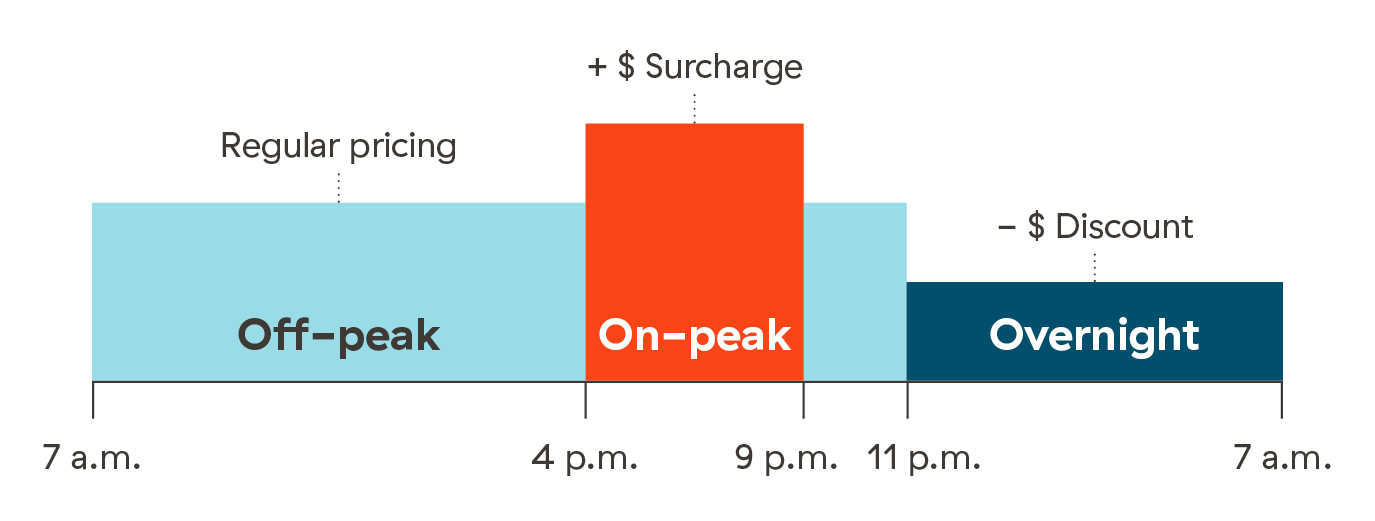
Time-of-day pricing only applies to your consumption – the electricity you draw from our grid when you need it. It does not apply to your generation back to our grid.
This means that:
By combining a generation system with time-of-day pricing, you can further reduce your electricity costs. We expect that the average residential self-generation customer with a solar panel system and electric heating would save about $52 per year on this rate plan, even without changing their daily habits.
Ways to save more:
Want to opt in to time-of-day pricing? Change your rate plan online.
If you're registered in Team Power Smart, you'll be unenrolled if your self-generation application is approved. Any active Team Power Smart challenges will be cancelled.
Yes, even if it’s a small generation system, or one that won’t have any outflow to our grid, you need to apply and get approval before connecting your system to our grid.
This is a requirement from the Canadian Electrical Code, which stipulates that any customer who wants to connect a generating system to the electrical grid must meet their utility’s interconnection requirements and receive approval prior to connecting.
More importantly, it’s important for the safety of our electrical workers.
An unauthorized grid connection is any load-side generation source connected to our grid that we haven’t approved. This can include connections made without the proper permits or those that don’t comply with applicable safety standards.
Unauthorized grid connections pose significant safety risks and legal implications. They can endanger both the property owner and the broader community by potentially causing electrical faults, equipment damage, or fires.
We use various methods to detect unauthorized grid connections including routine inspections, monitoring systems, and reports from the community.
Unauthorized connections can lead to fines, service disconnection, and a service reconnection fee. If you have an unauthorized connection, you’re responsible for all associated costs. However, if the service disconnection was made in error, you can discuss your situation with us to see if any exceptions apply.
If you discover that you have an unauthorized grid connection:
Beginning June 1, 2026, solar and battery installations must be completed by a Home Performance Contractor Network (HPCN) member in order to be eligible for rebates.
HPCN members have completed training on the requirements of the self-generation and rebate programs, are in good standing with WorkSafeBC, have up to date business licenses, general liability insurance and provide standard warrantees. HPCN members are independent contractors and not affiliated with or employees of BC Hydro.
HPCN members will:
When looking for a contractor, be wary of claims that sound too good to be true, like “free solar,” aggressive sales tactics, or requests for in-kind contributions, like manual labor, in exchange of free solar installation.
Before signing a contract for a solar installation, we recommend obtaining multiple quotes, comparing offers, and taking time to review your options. New consumer protection requirements include restrictions on high-pressure door-to-door sales practices. Learn more about your consumer rights by visiting Consumer Protection BC's website.
When you apply for customer generation, BC Hydro reviews the technical requirements of your request to determine whether the existing electrical infrastructure can support your system. In some cases, upgrades are needed to ensure your system can connect safely and reliably. This assessment considers factors such as:
These technical considerations determine whether your request qualifies for an express connection or requires a more detailed design connection process. You can learn more about these types of connections here.
For every proposed interconnection of a generating facility to the grid, BC Hydro must conduct an interconnection study. Whether an interconnection study is required is based on the discretion of our engineers.
The purpose of this study is to assess whether the generating facility’s maximum power output can be safely and reliably interconnected with BC Hydro’s system without modifications or whether upgrades to the local grid will be required to accommodate the interconnection.
If a study is required, our team will inform you and of any applicable fees. Fees depend on the scope and complexity of the study.
Landlords and developers can apply for self‑generation by submitting a self‑generation application using the BC Hydro account number and legal account holder name for the service address where the system will be installed.
Landlord or developer declaration form [PDF, 175 KB] must also be completed to confirm ownership or authorization, and all details such as the account name, account number, and service address must match across both documents.
You can apply by submitting a self‑generation application. However, new construction projects are typically classified as complex applications. Since the electrical service is not yet fully established, BC Hydro may require additional information such as site plans, load details, and design drawings to assess your request and determine the infrastructure needed to support your future generating facility.
For projects located in our non-integrated areas (NIAs), we strongly recommend waiting to purchase generating equipment until after the self-generation application is reviewed and accepted by us.
NIA systems use a variety of resources to support their electricity load, such as diesel, existing or proposed independent power producer (IPP) renewable generation, and intermittent energy via self-generation. That complexity requires us to perform a thorough technical review of each self-generation application received for projects located in an NIA, so we can ensure that we’ll be able to continue to provide reliable and cost-effective electricity to you.
Learn about rebates and how to apply in non-integrated areas.
Being in a constrained area means the local electrical system has limited capacity available to support additional load or new self‑generation.
In these areas, the existing infrastructure such as transformers, distribution lines, or substations may already be operating near their limits. As a result, BC Hydro may not be able to accommodate new generation export or increased electricity demand without upgrades. This can affect whether your self‑generation system can be connected, how much you're allowed to export, and whether additional studies or system improvements are required before approval.
For questions about self-generation and the application, please email us.
Visit our self-generation page for program details and resources.
You can manage your self-generation application and account through MyHydro.